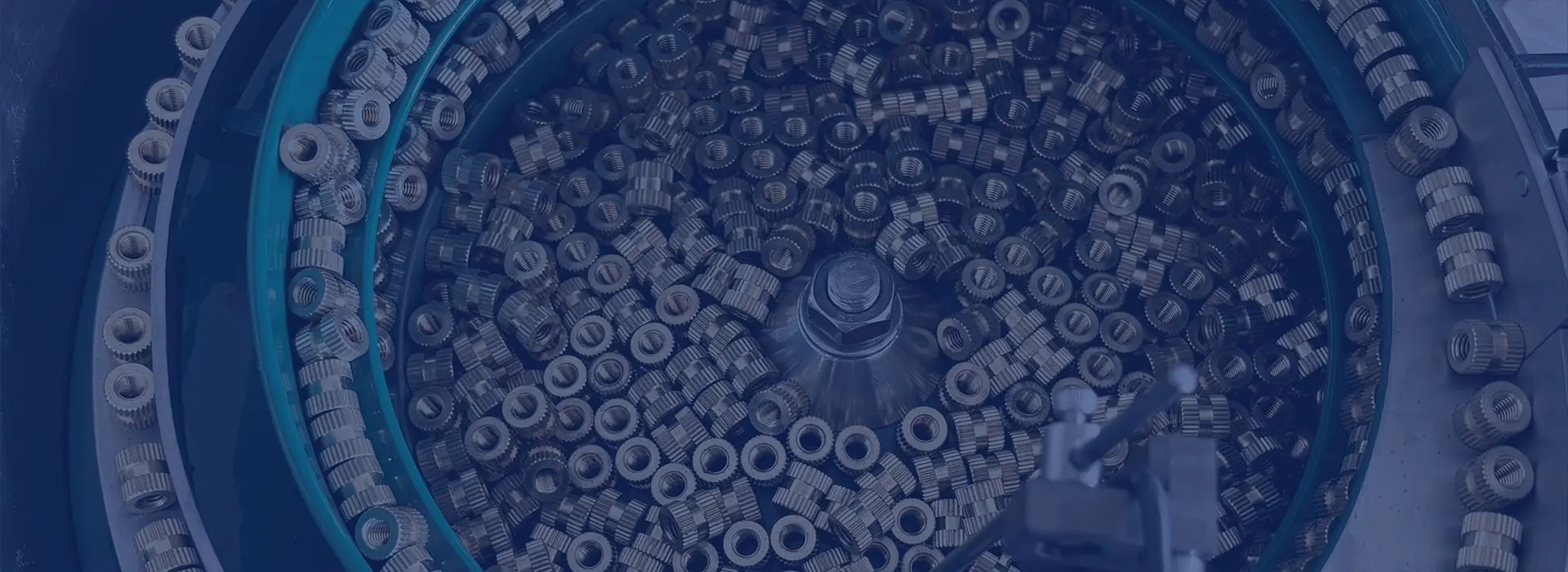
Threaded ring-shaped metal components in a circular feeder bowl.

Feeding technology · application engineered

Vibratory bowl feeders for controlled component orientation.

Application-engineered vibratory bowl feeders for sorting, orienting and presenting industrial components to automated assembly and manufacturing equipment.

Direct answer

What this system does.

A vibratory bowl feeder uses controlled vibration and application-specific track tooling to separate bulk parts, reject incorrect attitudes and deliver accepted components in a repeatable orientation.

Where it can fit.

Selection starts with the component, accepted discharge condition and receiving process. This technology is commonly assessed for:

01

Screws, nuts, washers and inserts

02

Clips, pressings and small mouldings

03

Stable products with a defined orientation

04

Dedicated, repeatable production formats

Specify the complete path.

The sorter is only one stage. Bulk storage, metered replenishment, orientation, inspection, linear buffering, sensing and final release must work together under normal production conditions.

Performance evidence

Measure accepted output at the hand-off.

For a bowl feeder, prove the tooling, recirculation and accepted discharge with the component trial and FAT method, then define the outlet and signals in the integration guide.

Trials should include representative variants, replenishment, recirculation and agreed intervention rules.

01

Define the component range

02

Agree orientation and datum

03

Set sustained rate and duration

04

Include the machine interface

Straight answers

Common component-feeding questions.

Final suitability and performance are confirmed against the actual part and agreed trial criteria.

How does a vibratory bowl feeder work?+

Controlled vibration moves loose parts up a spiral track. Part-specific tooling uses geometry and centre of gravity to reject wrong attitudes and deliver accepted components at the outlet.

Which parts are suitable for a bowl feeder?+

Repeat components with usable orientation features and stable contact behaviour are good candidates. Tangling, soft materials, delicate finishes or very frequent format changes may favour another route.

Can one bowl feeder handle several formats?+

Sometimes, where sizes and behaviours are compatible. Adjustable guides or change tooling can be considered, but every format and the changeover method should be proven before design freeze.

Start an application review

Send us the component. Get a clear starting recommendation.

Share photographs or drawings, variants, material and finish, required orientation, target sustained output and details of the receiving machine.

Call project team01844 617223