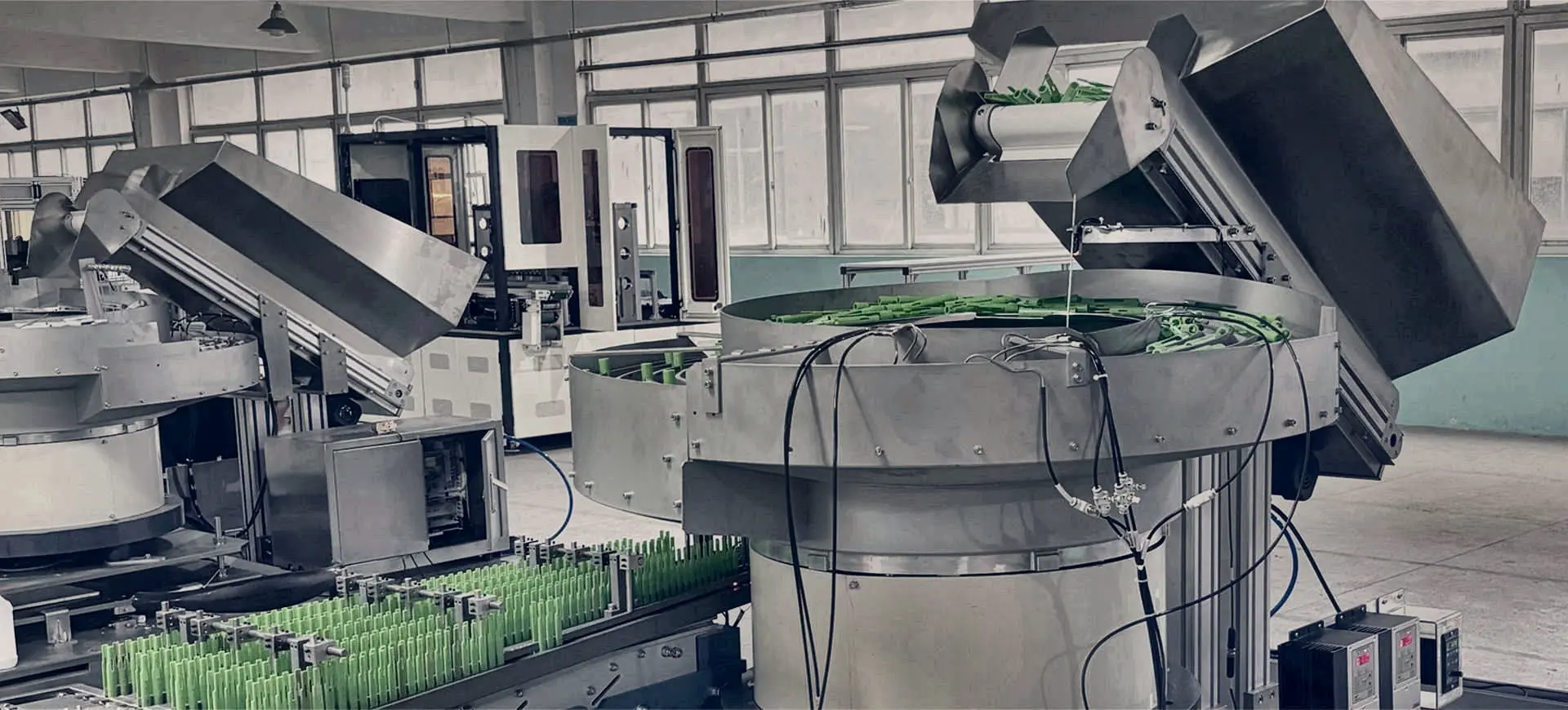
Bowl feeders and hopper elevators with green components on the feeding line.

Mechanical hand-off · controls · commissioning

Component feeder integration for machines, robots and assembly cells.

Plan the feeder, buffer, presentation point and control handshake as one production interface—not as separate equipment bought in isolation.

Engineering guidance · reviewed 1 September 2026 · UK-wide project support

Integration guide

Component feeder integration connects the physical part flow to the downstream machine demand. A successful interface defines where the accepted part is presented, how it is detected, when it is released and how each machine responds to ready, blocked, low-level and fault conditions.

Start at the final hand-off

The outlet—not the feeder bowl—is the best place to define success. Confirm the part datum, presentation accuracy, outlet height, queue length, back pressure, allowable contact and whether the next process picks, blows, slides, inserts or indexes the component.

Mechanical and controls boundaries

Record which party supplies the stand, chute, escapement, guards, cables, valves, sensors, PLC changes and final machine safety work. A simple interface schedule prevents gaps between the feeder supplier, robot integrator and machine owner.

Final presentation may use a gravity track, linear track, escapement, dead nest or robot pick point. Define selectors, rejects, recirculation and queue pressure as part of the feed path. See Sortation Solutions' escapements and tooling overview for the dedicated hand-off scope.

Track fullPause upstream flow before the queue overloads.
Part presentConfirm one accepted component is at the release or pick point.
Bulk lowCall for replenishment with enough time to avoid starvation.
Fault / resetExchange controlled states with the parent machine.

Controllers and sensors should be selected around the real queue, environment and machine standard. Review the wider feeder controllers and sensor options before freezing the interface schedule.

MECHANICAL

Footprint, outlet height, datum, access and product transfer.

ELECTRICAL

Power, panel boundary, sensors, valves and cable routes.

CONTROLS

Demand, ready, track full, low level, fault and reset signals.

SAFETY

Guarding, stop behaviour, recovery and conformity responsibilities.

Integrating with a robot or cobot

Robot feeding also depends on pick availability, gripper design, camera field, lighting, part overlap, regrip strategy and what happens after a missed pick. For flexible feeders, the total cycle includes part redistribution and image acquisition as well as robot motion.

An existing machine can often accept a new feeder when the condition, footprint, guarding, safety ownership and controls access are suitable. A retrofit survey should confirm the datum, services, signal ownership and recovery sequence before manufacture. See the separate parts-feeder retrofit and integration checklist.

Commission against realistic production demand

Factory tests should use representative parts and simulate downstream calls, blocked conditions, replenishment and normal operator recovery. Site acceptance then confirms services, machine signals, guarding and the complete operating sequence in the installed line.

Specification detail

Typical feeder-to-machine signals.

AreaWhat to defineWhy it matters
Demand / callDownstream machine requests parts.Avoids overfeeding a full track.
Feeder readySystem is enabled and can respond.Lets the parent machine control its cycle safely.
Part presentAccepted part is at the hand-off.Confirms the next operation can start.
Low levelBulk stock is approaching its refill point.Provides time for replenishment before starvation.
Fault / resetStops and recovery states are exchanged.Makes faults visible and recovery controlled.

Engineering note: Final equipment suitability, output, safety, environmental performance and supplied scope must be established for the actual component, process and site.

Straight answers

Questions buyers and engineers ask.

These answers provide a practical starting point; representative parts and an agreed application review determine the final recommendation.

Can a feeder connect to an existing PLC?+

Yes, subject to hardware, software access and the customer standard. The interface may use hardwired I/O or an agreed industrial network.

Can a component feeder be retrofitted to an existing machine?+

Often, if the hand-off, available space, guarding, controls and remaining machine condition support a practical interface review.

Who supplies the final guarding?+

Responsibility must be stated in the contract and risk assessment. The party placing the complete assembly into service must ensure the overall conformity process is completed.

How is line starvation prevented?+

Bulk level sensing, controlled replenishment, track buffering and early alarms provide time to respond before the downstream process runs empty.

What should be tested before site installation?+

Test the agreed parts, normal demand signals, blocked track, low level, fault recovery, output condition and any changeover that is within scope.

Start an application review

Send the component. Define the hand-off. Compare the right feeder routes.

Share photographs or drawings, variants, material and finish, required orientation, target sustained output and details of the receiving machine.

Call project team01844 617223