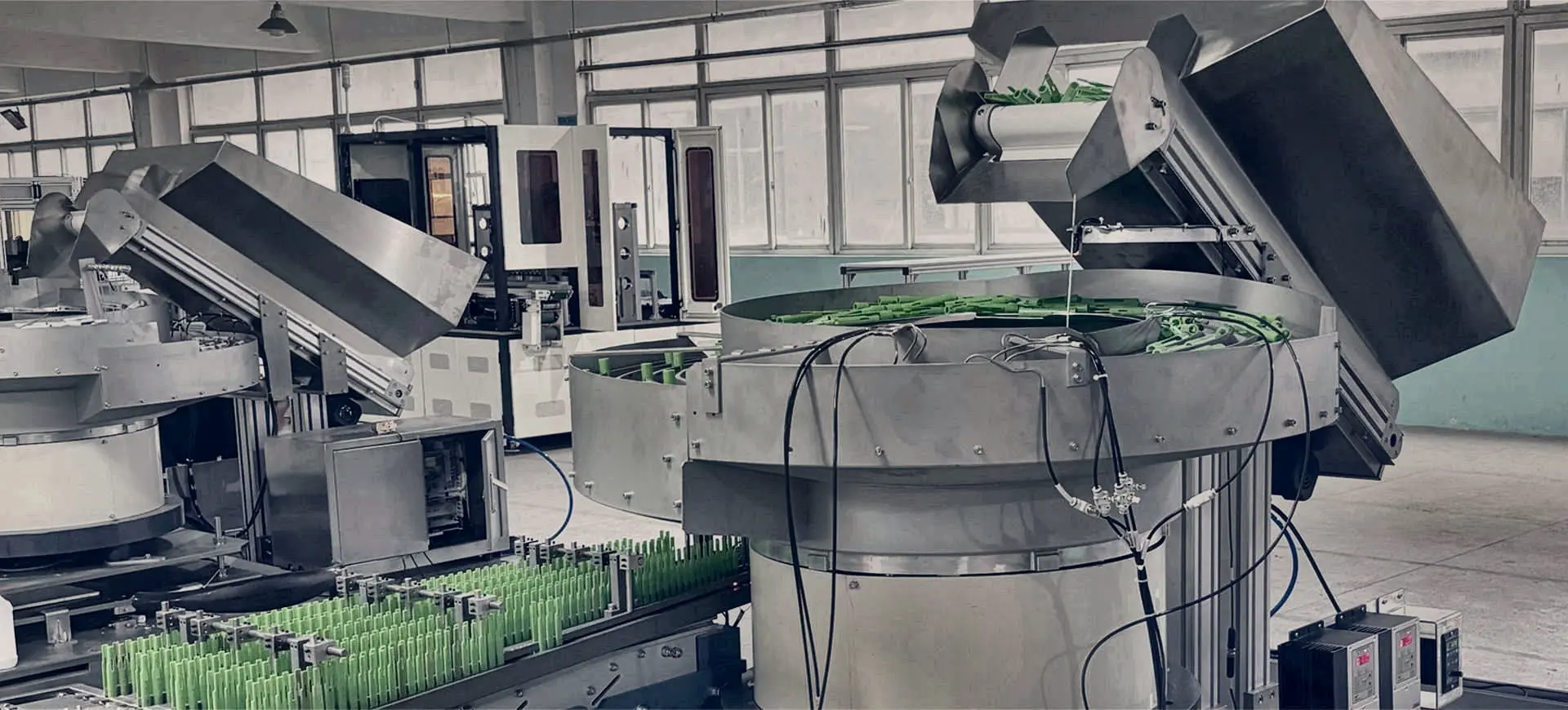
Bowl feeders and hopper elevators with green components on the feeding line.

Feeding technology · application engineered

Flexible feeders for changing products and difficult geometries.

Flexible component feeder systems combining programmable part presentation, machine vision and robots for multiple variants and complex automated handling.

Direct answer

What this system does.

A flexible feeder redistributes parts on a controlled surface so a camera can locate pickable components and guide a robot. It is considered where format variety or difficult geometry makes dedicated tooling impractical.

Where it can fit.

Selection starts with the component, accepted discharge condition and receiving process. This technology is commonly assessed for:

01

Multiple product variants

02

Delicate or cosmetically sensitive parts

03

Short runs and frequent changeovers

04

Robot placement with programmable orientation

Specify the complete path.

The sorter is only one stage. Bulk storage, metered replenishment, orientation, inspection, linear buffering, sensing and final release must work together under normal production conditions.

Performance evidence

Measure accepted output at the hand-off.

Validate every format, redistribution cycle and pick condition through the component trial method, then include camera, robot and recovery states in the integration brief.

Trials should include representative variants, replenishment, recirculation and agreed intervention rules.

01

Define the component range

02

Agree orientation and datum

03

Set sustained rate and duration

04

Include the machine interface

Straight answers

Common component-feeding questions.

Final suitability and performance are confirmed against the actual part and agreed trial criteria.

When should I choose a flexible feeder instead of a bowl feeder?+

Flexible feeding is attractive for frequent changeovers, product families or geometries that are difficult to orient with fixed tooling. A dedicated bowl may still be simpler and faster for one stable, high-volume part.

How many component variants can a flexible feeder handle?+

There is no universal number. Platform size, part overlap, lighting, camera field, robot gripper and recipe validation determine the practical family. Every intended variant should be tested.

How is flexible-feeder output calculated?+

Use the complete cycle: bulk dosing, redistribution, settling, imaging, pickable-part ratio, robot motion, placement and recovery. Sustained accepted output is more useful than a single best pick time.

Start an application review

Send us the component. Get a clear starting recommendation.

Share photographs or drawings, variants, material and finish, required orientation, target sustained output and details of the receiving machine.

Call project team01844 617223